
“Maybe you were a memoirist.” Ezra shrugged. “But identity changes all the time, I’ve found. There’s a few more ‘yous’ you haven’t met yet.” – A Love Song for Ricki Wilde, by Tia Williams
Summer 2024
When I first quit my job I read. A lot. Part of it was making up for lost time. I wanted to catch up on all the things I missed. During my 13 years as an educator I read a lot for work. At the time my focus was becoming a phenomenal educator, so I read many books on pedagogy, educational leadership, middle grade fiction, and YA. Lots of YA. Baby, we still read YA. YA never gets old. Lol. While I enjoyed the YA, I didn’t read much outside of work. So when I decided to read again, part of it was about rediscovering the version of me that existed before I defined myself as an educator. I wanted to get to know that person again. Learn her interests, her hobbies, her passions. I’d lost touch with her. In trying to find her again, I remembered she always had a book in her hand. If we were going to get reacquainted, I knew I had to read voraciously. Reading for pleasure, not work.
One of my first reads that summer was A Love Song for Ricki Wilde by Tia Williams. It was a funny read about a florist who falls in love with a pianist from the Harlem Renaissance era who’s been cursed to live forever. While reading it I stumbled upon the quote at the beginning of this entry, and I had to write it down. When I wrote it, I wrote it like this:
“Maybe you were (an educator)…But identity changes all the time…there’s a few more you’s you haven’t met yet.”
The quote got me to thinking, Who told you, you had to do the same thing your entire life? Why did you believe it? Why did you put yourself in a box? and Who’s the version of you you haven’t met yet?
For a long time I convinced myself I was stuck in education because most of my work experience after college has been in that industry. Any time I thought about pursuing something else I’d come up with a laundry list of reasons of why it made sense to stay put.
- You’ll have to start over.
- You’ll have to take an entry level job.
- You’ll have to take a pay cut.
- You’ll have to go back to school.
- You’ll have to work for free to get “experience.”
- You’ll have to build your credibility in a new industry. That takes time.
Thoughts like these paralyzed me and kept me in education eight years longer than I intended. I was afraid to start over. If I’m being honest it felt like I was already behind in the career race. I was working in a profession where the pay was no comparison to the hours spent working. It is well known that educators are underpaid and undervalued. Instead of paying well to retain good talent, if one has the balls to speak up one is met with mottos like, “Be a team player,” “It’s for the kids,” “We can do hard things,” or “We’re a family.” Hearing things like this from leaders can do a number on your psyche, especially when you believe they have pure intentions so you find yourself working insane hours for very little pay and very little recognition. The thought of starting over when I already felt underpaid for the value I bring terrified me. In hindsight I was seeking security and thought I had it by staying put. I now see that the security I thought I had was an illusion. I was too attached to what I knew that I was hindering myself from growing. There’s no evolution in sticking to what we know. If our heart’s desire is truly to grow we have to embrace the unknown. That’s where the possibilities lie. That’s where excitement and adventure reside. That’s where you discover the version of yourself you haven’t met yet.
Step 1 in Career Design: Start Where You Are
Another book I picked up that summer was Designing Your Life: How to Build a Well-Lived Joyful Life by Bill Burnett & Dave Evans. I was reviewing my materials from the course I took on designing a career you love one day and noticed at the bottom of one of the pages that the creators of the course got a lot of their ideas from this book. I found it interesting that the book was about designing your life, not about designing a career. I bought the book and the journal on Amazon, curious about designing a joy filled life.
In chapter one of the book the writers claim that “before you can figure out which direction to head in, you need to know where you are, and what design problems (in your life) you are trying to solve.” I took that to mean I need to have an honest conversation with myself about where I am now. This should happen before I figure out what industry I should be pursuing. It should also happen before I start working on other areas of my life. To do this, one of the first reflection exercises I completed from the book was the Health/Work/Play/Love Dashboard. I found it very insightful. My results made me not want to immediately look for jobs. I realized there were other areas of my life that were more important to improve than finding work.
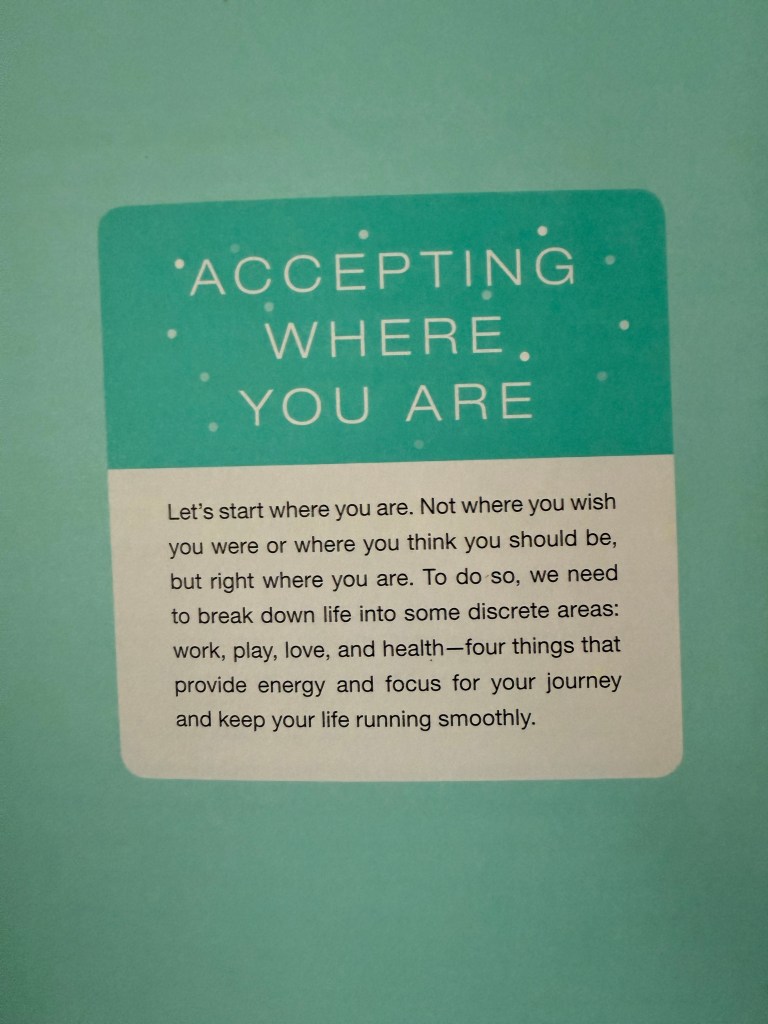
How’s your health?
First, I assessed my health. The writers defined health as “being well in mind, body, and spirit- emotional health, physical health and mental health.” To do the assessment you rank how well your health in these areas are on a gas tank. Is your health on E (empty)? Is it on F (full)? Do you have half a tank? A quarter of a tank?
At the time I ranked my health as being a quarter of a tank. I felt that way because I didn’t have a regular physical exercise routine and was unhappy with my postpartum body. In addition, I wasn’t in a good space emotionally. At the time I wasn’t allowing myself space outside of my husband to process my emotions. I dumped on him a lot. I thank him for being there for me but I’ve since learned better ways to process my feelings. Finally, I felt my spiritual health was okay but there was room for improvement. I was reading the verse of the day on the Bible app daily, going to church on Sundays, doing Bible study virtually mid week and listening to gospel music daily. These actions helped me find peace in difficult moments during the week. However, the assessment made me realize I needed to take more steps to deepen my spiritual connection with God and the universe to be in a better space when it comes to my health.
How’s your work life?
Next, I assessed my work life. According to the authors work includes:
“what you’re getting paid to do…your 9-5 and your second job if the first isn’t enough, and any consulting or advising you do. If you’re a regular volunteer in any organization, figure that in, too. If you are a homemaker…raising children, providing home-cooked meals for your family, taking care of aging parents, and doing housework are all forms of work.”
I ranked my work life as half a tank full. I considered my 9-5 and homemaker roles when deciding where to put my tank.
How’s your play life?
Third, I evaluated my play life. In the book play is defined as:
“…activity that brings joy just for the pure sake of doing it. It can include organized activity or productive endeavors, but only if they are done for fun and not merit…all lives need some play and making sure there is some play in our day is a critical life design step.”
Ranking this tank was difficult for me. I had to search my brain. I was really sitting at my desk asking myself, “When’s the last time you did something just for the fun of it? You weren’t going to earn anything from doing it. You did it just for pure joy.” Yo, when I tell you there was a pause… I was like, “Did I stop having fun when I had my babies?”
To be clear, it is not my children’s fault that I stopped making space in my life for play for myself. I think I just got so caught up in attending to their needs and staying on top of things at work that I forgot to be intentional about having fun. Furthermore, somewhere along the way I stopped planning for fun with my husband. I think we both let money or the kids be an excuse. This one made me think, “No wonder you been so tense, sis. You stopped having fun.”
I was able to come up with one thing I’d been doing since the pandemic for the sheer fun of it. I’m in a virtual book club with some of my girlfriends. We read a book for pleasure monthly (or bi monthly when we get busy) then we meet online to discuss. I look forward to it because they choose books I probably wouldn’t have on my own and I get to catch up with them. I think because it’s a standing meeting on our calendar we tend to honor it. Outside of book club though, I had work to do increasing play in my life.
One last thing on play. When it came to my attention that I neglected play in my life, all these memories came back to me of things I used to do just for fun. I knew I needed to bring them back and/or discover new things just for the sake of doing them. Here’s a list of the things that came back to memory:
- Ride my bike
- Journal
- $5 movie on Tuesdays at Cinemark
- Read fiction
- Walk
- Listen to live music
- Go to food & art festivals
- See live theater
- Go to museums
I ranked play at a quarter tank full. I probably should have ranked it at half a quarter tank in hindsight, lol. There was work to do!
How’s your love life?
Fourth, I evaluated my love life. When it comes to love the authors remind us:
“…love makes the world go around, and when we don’t have any, our world isn’t as bright and alive as it could be…it arrives in a wide range of forms. Our primary relationship is where we go first for love, children typically come next, and then it’s a flood of people and pets and community and anything else that is an object of affection. And it is as critical to feel loved by others as it is to love – it has to go both ways.”
I found this tank the easiest to rate. My love tank was full. I had (and still have) a lot of love in my life. My husband, my children, my parents, my brother, my friends, my cousins, my aunts/uncles… the list goes on and on. These relationships sustain me through the joys and pains of life. In this season I am constantly reminded to tap into my connections. We were created to be relational beings. It makes sense that to get ahead in life we often have to tap into our bonds to keep going.
Where Are You Challenge
After completing my dashboard I had to reflect some more. The authors include more questions in the journal to ask oneself. The questions included were:
- How do you feel about your gas tanks?
- Do they look balanced?
- Are there any areas approaching full? Does that feel good or bad?
- Are any areas empty? How do you feel about that?
- Which areas could use action, improvement, or innovation?
- What obstacles might stand in your way?
- Are there any specific problems, you would like to tackle? If so, what are they?
Something I’ve taken away from this book and from my own journey is that you can’t know where you’re going until you understand where you are. I’ve also learned there isn’t necessarily a clear destination. This was hard to accept at first. In my past I planned everything. In education it’s called “backwards planning.” “Plan with the end in mind!”
In my life design journey I am having to unlearn past ways to make way for new habits. That career coach I talked to you about in my first post told me, “The old you has to die for the new you to thrive. I know you don’t want to hear that but that’s the way it is.” She’s right. So a big part of this journey for me has been letting go. I don’t want to be so attached to an idea of what I think will bring me joy that I block what God has for me that is so much better than what I could have conceived.
Doing an honest evaluation of my health, work, play and love was a critical step in helping me to evolve into a more balanced, wiser, stronger version of myself. I hope me sharing this with you inspires you to complete your own assessment of where you are now. It opens a world of possibilities. I hope you join me.
Until next time,
Jeanine


 Jeanine Thomas
Leave a reply to jeaninethomas Cancel reply